18 May 2026
RNG Verification Protocols Across Licensed Casino Software for Slots, Poker, and Bingo
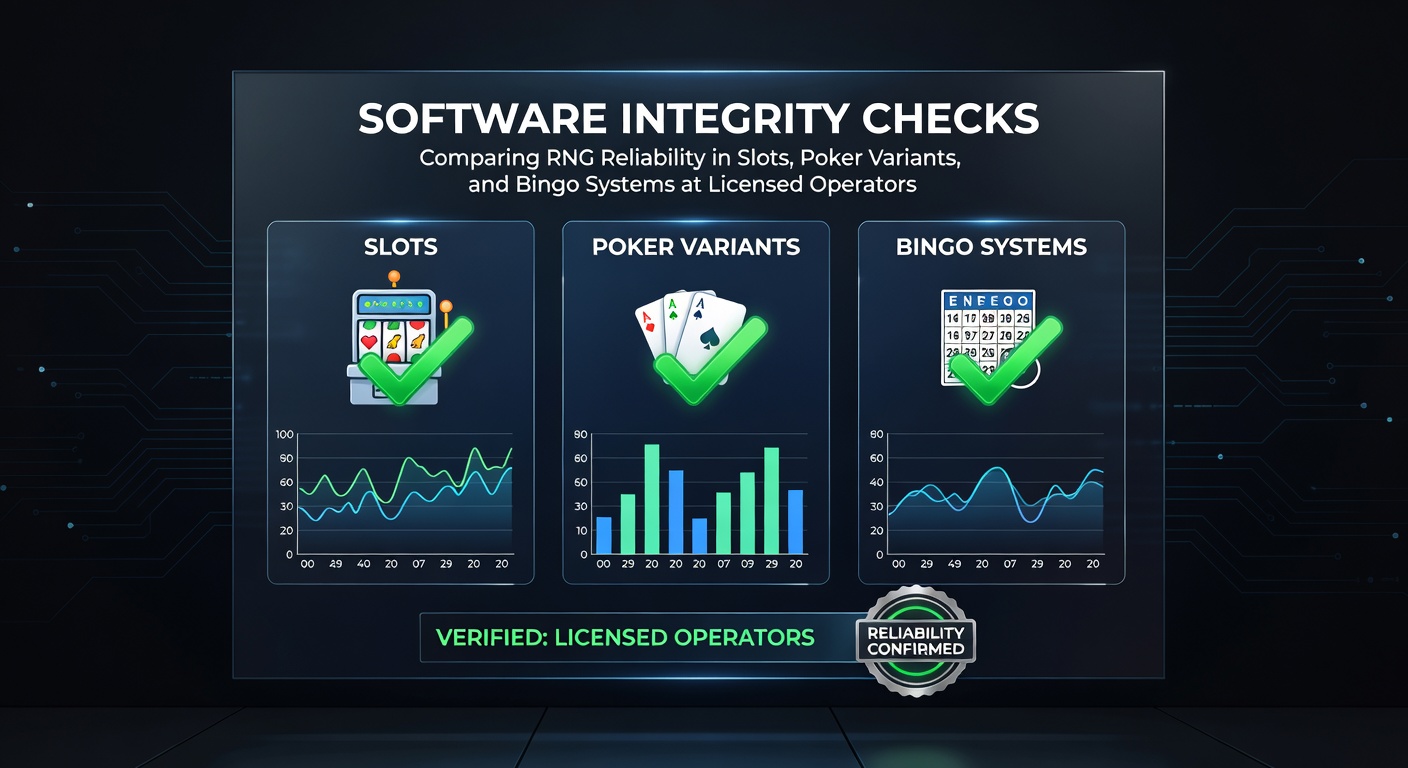
Software integrity checks form the backbone of fair play at licensed operators, where random number generators determine outcomes in slots, poker variants, and bingo systems, and regulators require documented testing cycles that verify statistical randomness across millions of simulated results. Licensed platforms submit their RNG modules to independent laboratories that run battery tests including diehard, NIST, and chi-square analyses, while operators maintain audit trails that record every seed value and output sequence for later review.
Core RNG Components in Digital Gaming
Random number generators in casino software rely on algorithms that produce unpredictable sequences, yet true randomness comes from hardware entropy sources such as thermal noise or radioactive decay that feed into cryptographic hash functions. Slots typically employ linear congruential generators or Mersenne Twister variants scaled to reel positions, whereas poker variants use separate RNG streams for card shuffling to prevent predictable deck orders during multi-player sessions.
Bingo systems integrate RNG calls that select numbered balls in real time, and operators combine these draws with timestamped verification to ensure each game round remains independent from previous ones. Researchers discovered that weak seed initialization can create detectable patterns, so licensed operators now enforce reseeding protocols every few milliseconds during active play.
Testing Standards Applied to Slots
Slot RNG reliability receives the most scrutiny because these games generate the highest volume of spins per hour, and testing houses simulate at least 100 million outcomes before issuing certification. Data from regulatory filings shows that approved slot titles maintain return-to-player percentages within 0.1 percent of their theoretical values across extended play periods.
Operators conduct ongoing monitoring that flags any deviation exceeding two standard deviations from expected distribution, and they pause games automatically until re-certification occurs. One study revealed that early RNG implementations occasionally failed long-run frequency tests, which prompted stricter entropy collection requirements now standard in licensed jurisdictions.

Poker Variants and Shuffling Integrity
Poker software demands additional layers of RNG protection because players receive multiple cards per hand, and any bias in shuffling algorithms could influence flush or straight probabilities over thousands of deals. Licensed operators separate the RNG module that generates random values from the shuffling routine itself, applying the Fisher-Yates algorithm to reorder virtual decks while logging each swap operation.
Monthly audits compare actual hand distributions against theoretical probabilities, and platforms that host variants such as Texas Hold'em or Omaha must demonstrate that no sequence repeats within a rolling window of one million hands. Observers note that multi-table tournaments place extra stress on RNG throughput, which is why operators upgrade hardware entropy sources before peak traffic periods arrive.
Bingo Draw Systems and Sequential Verification
Bingo platforms generate number sequences that must remain uniformly distributed across the full range of 1 to 75 or 1 to 90 depending on the game format, and integrity checks include verification that every number appears with equal frequency over complete sessions. Licensed operators embed checksums into each draw packet so that remote players can confirm results match the server-side record without exposing the full sequence in advance.
Systems also track draw intervals to prevent timing attacks that might exploit predictable gaps between calls, and regulators require proof that network latency does not correlate with number selection. Figures reveal that certified bingo RNGs achieve pass rates above 99.8 percent on standard statistical suites when tested under simulated high-volume conditions.
Comparative Performance Across Game Types
Slots tolerate minor short-term variance because individual spins remain independent, while poker and bingo place stricter demands on sequence integrity due to the interdependent nature of hands and draws. Comparative reports from testing laboratories indicate that poker RNG modules undergo roughly 30 percent more test cases than slot equivalents, primarily to cover combinatorial explosion in possible card arrangements.
Bingo systems fall between these two extremes, requiring sustained uniformity across long draw sequences yet demanding less computational overhead than full poker shuffles. Licensed operators often deploy unified RNG cores that feed different post-processing layers tailored to each game type, which simplifies maintenance while preserving statistical properties specific to each title.
As of May 2026, several major testing agencies updated their certification frameworks to include machine-learning anomaly detection that identifies subtle correlations missed by traditional statistical batteries. Operators who adopted these enhanced protocols report faster approval turnaround times and fewer post-launch adjustments.
Conclusion
Software integrity checks continue to evolve alongside gaming technology, and licensed operators maintain transparent documentation that demonstrates RNG reliability across slots, poker variants, and bingo systems through repeated independent verification. Consistent application of statistical testing, entropy sourcing, and real-time monitoring ensures that outcomes remain unpredictable and fair for all participants regardless of game format.