8 Jul 2026
Exploring Probability Structures in Traditional Board Games and Digital Alternatives
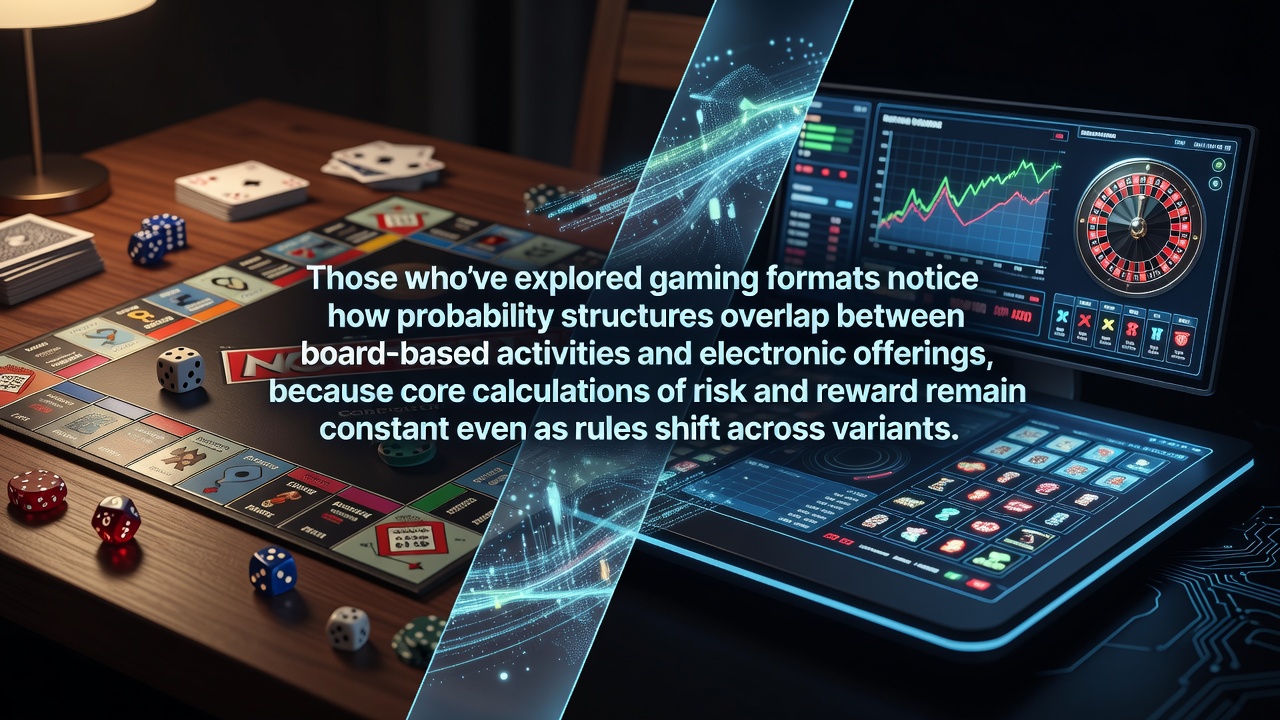
Those who've explored gaming formats notice how probability structures overlap between board-based activities and electronic offerings, because core calculations of risk and reward remain constant even as rules shift across variants, and data from multiple studies confirm these shared mathematical foundations across decades of game development.
Board games rely on physical components such as dice and cards to generate outcomes, yet the underlying odds follow predictable patterns that researchers have documented since the mid-20th century, while electronic versions replicate these mechanics through algorithms that produce equivalent distributions, and observers note the continuity in how players assess potential gains against possible losses.
Core Mathematical Principles in Physical Board Formats
Dice-based board games establish clear probability baselines that carry through multiple rule sets, and studies from institutions like the University of Nevada's International Gaming Institute show how repeated rolls create expected values that inform strategic decisions, whereas card shuffling in games with decks introduces combinatorial elements that players calculate in real time during sessions.
Take Monopoly as one case where property acquisition odds and rent calculations depend on landing probabilities derived from two six-sided dice, and analysts have mapped these frequencies to demonstrate that certain board positions occur more often than others over extended play, while similar dice mechanics appear in other titles with adjusted board layouts that preserve the same risk equations.
Transition to Electronic Gaming Environments
Electronic adaptations maintain identical probability frameworks through pseudorandom number generators calibrated to match physical distributions, and regulatory testing in jurisdictions such as Nevada and New Jersey requires independent verification that digital outcomes align with published mathematical models, yet the shift to screens removes tactile elements without altering the fundamental risk assessments players perform.
Research indicates that players who transition between formats often apply the same decision trees because expected value calculations remain unchanged, and figures from industry reports reveal consistent patterns in session lengths and wager sizing that reflect these enduring structures rather than platform-specific features.
Overlapping Risk and Reward Calculations

What's interesting is how variance and standard deviation metrics apply equally whether a game uses physical components or software, because both systems generate outcome sets governed by the same laws of large numbers, and data shows that long-term results converge toward theoretical probabilities in both environments despite short-term fluctuations that players experience.
One study revealed that participants familiar with board versions adapted quickly to digital interfaces precisely because they recognized recurring probability clusters, and analysts attribute this transferability to the invariance of core equations even when visual presentations and interaction methods evolve.
July 2026 brings new software certification standards in several regions that emphasize transparency in random number generator documentation, and these updates build on existing frameworks used by testing laboratories to ensure equivalence between physical and electronic probability models across an expanding range of game types.
Practical Examples of Shared Structures
Games involving sequential decisions highlight the persistence of risk evaluation methods, and players calculate conditional probabilities based on prior outcomes in both physical and digital settings, whereas multi-player interactions add layers of opponent modeling that rest on the same statistical foundations regardless of delivery method.
Evidence suggests that educational programs teaching probability through board games produce measurable improvements in understanding digital variants, because the numerical relationships transfer directly, and academic papers document these learning effects across controlled experiments conducted over multiple years.
Conclusion
The continuity of probability structures across board-based and electronic gaming demonstrates that mathematical principles operate independently of physical form, and regulatory bodies together with research institutions continue to document these consistencies through ongoing analysis and testing protocols. Players who recognize these overlaps gain clearer perspectives on how decisions influence outcomes, and available data supports the view that core risk calculations endure as formats diversify.